
Watch your review happen with PICO Portal PLUS+
Systematic review services, planned back from your deadline. Assigned methodologists work in your own PICO Portal workspace, and you see every decision as it is made.
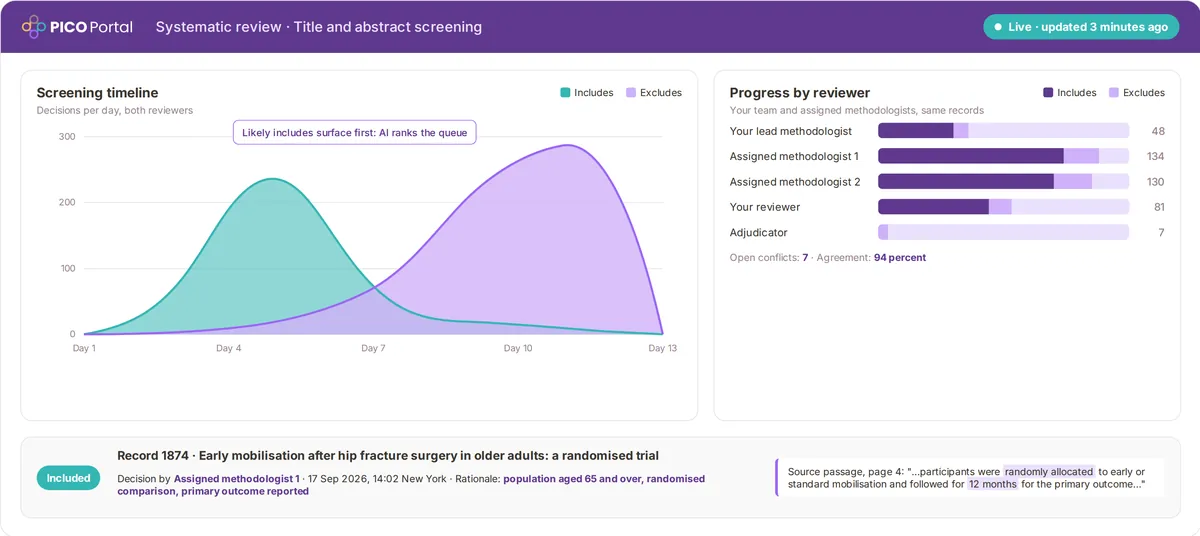
For guideline developers, HTA and HEOR teams, medical societies, and academic and government review teams.
When a conclusion is questioned, can you show who excluded this study, and on what passage?
With PICO Portal PLUS+ the answer is on the record: named reviewer, timestamp, rationale, and the source passage, open to your team while the review is still being built.
Planned back from your deadline
One review or a full program of reviews, at a fixed scope and a fixed price agreed before work starts.
Every decision, as it is made
You see the queue, the conflicts, the pace, and the agreement while the stage is still open.
You keep the judgment
Assigned methodologists make the eligibility decisions. Certainty of evidence, synthesis, and the conclusions stay with your team.
What we do
We run the evidence review. You keep the judgment.
Reviews run on fixed dates: grant and submission deadlines, committee and board cycles, publication windows. The evidence review underneath has to be finished on time and has to hold up when a conclusion is challenged. Few teams keep a permanent review staff, so capacity is hard to add exactly when a project needs it. And handing the review out usually means waiting for a spreadsheet, with no view of how it was built.
PICO Portal PLUS+ runs your evidence review in your own workspace on the PICO Portal platform. Assigned methodologists from our network work to your protocol. You watch the review as it changes, so you can course-correct while the stage is still open.
PICO Portal PLUS+ delivers
Your team keeps
One workflow, on the same records
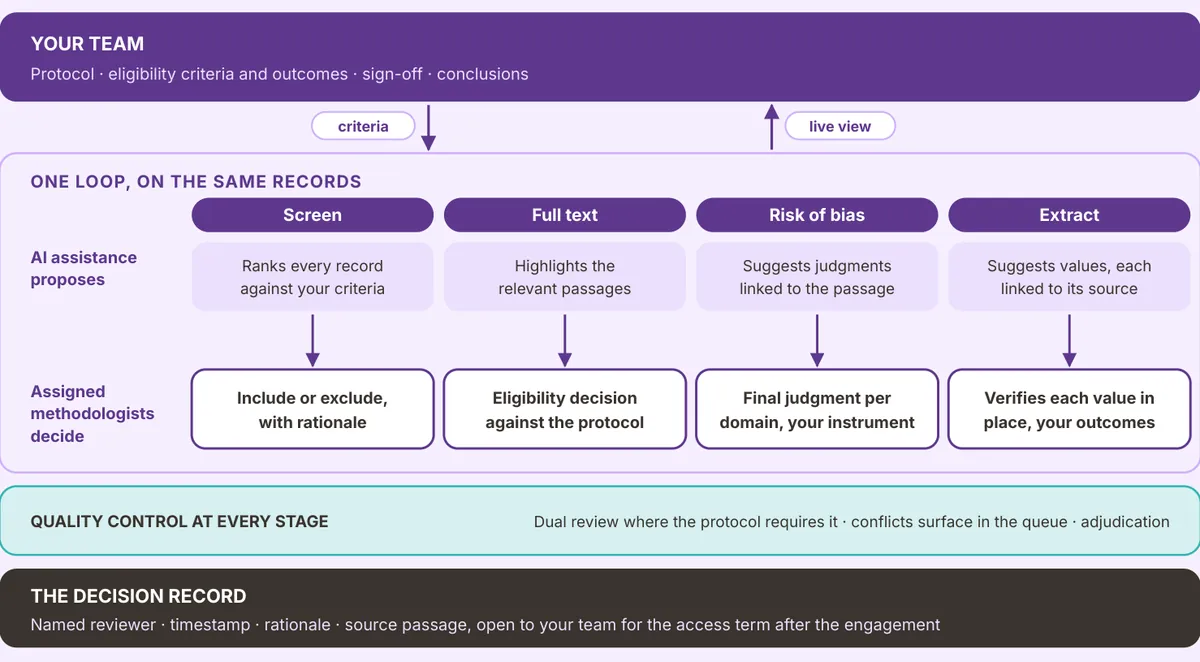
AI assistance proposes. Assigned methodologists decide.
At screening, full text, risk of bias, and extraction, AI assistance ranks records, highlights passages, and suggests values. Assigned methodologists make every include, exclude, and risk of bias judgment, and verify each extracted value against its source.
Quality control at every stage
Dual review where the protocol requires it. Conflicts surface in the queue and go to adjudication.
The decision record
Named reviewer, timestamp, rationale, and source passage for every decision, open to your team during the engagement and for the access term after it.
Questions
Built to hold up when the evidence is challenged.
Who makes the eligibility decisions?
People. AI assistance ranks records and highlights passages. Assigned methodologists make every include, exclude, and risk of bias judgment, and the record shows who decided and why. Each methodologist is matched to your subject area and calibrated against your criteria before production. Their agreement stays visible to you for the rest of the project.
Who controls the method?
You do. You set the protocol, and any change to it goes through you.
Can we start small?
Yes. A first engagement covers one review or one stage, at a fixed price agreed before work starts.
Where does our data sit?
In your workspace. Your project sits on the PICO Portal platform, hosted on Azure and AWS. Only the people you and we assign can access it, and we do not use your content to train models.
Case study
One large review, run in the client’s workspace
Digital health evidence for a global health investment
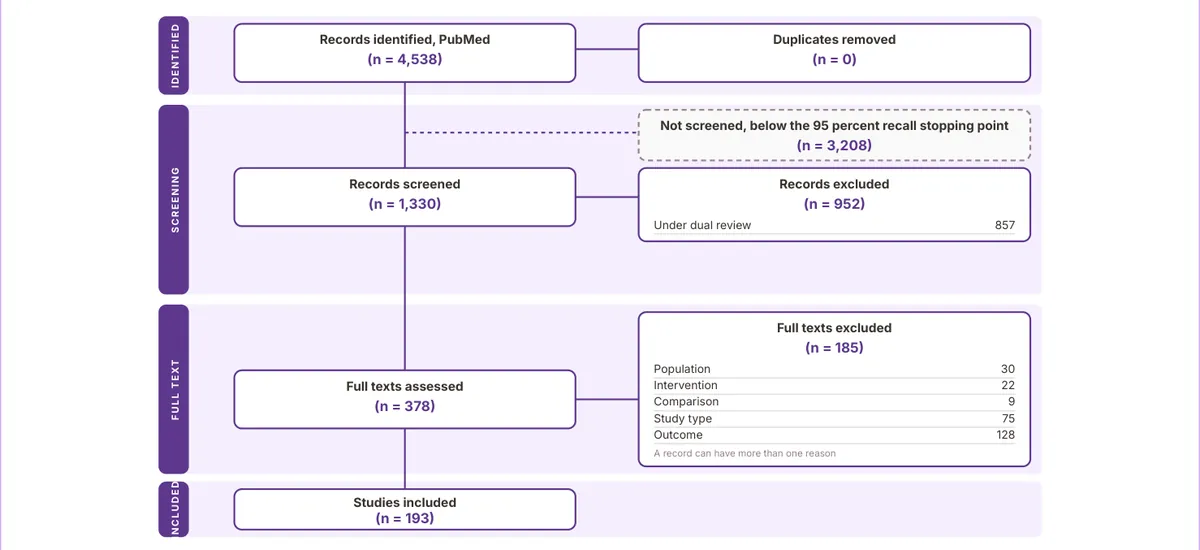
4,538 records. 1,330 screened. 193 studies included.
A global health research team needed the primary studies on digital decision-support tools, for clinical health workers and for patients, and their effect on the efficiency of service delivery in low- and middle-income countries. PICO Portal PLUS+ methodologists led title and abstract screening and full-text review in the team's own workspace; data extraction and risk of bias were done jointly with the research team.
Two reviewers screened the first 10 percent to calibrate against the criteria. Screening prioritization then ranked the remaining records, and screening stopped once estimated recall reached 95 percent. The 3,208 lowest-ranked records were reported as not screened, not as exclusions. Of 378 full texts assessed, 193 studies were included, with every exclusion coded by reason.
Have a review coming up?
Getting started
Start with one review.
1 · Scoping call
30 minutes on the review, the questions, and your deadline.
2 · Pilot
One review or one stage, fixed scope and fixed price, agreed in writing before work starts.
3 · Calibrate
Methodologists are assigned by subject area and calibrated against your criteria.
4 · Execute
The work runs in your workspace. Open it whenever you want: volume done, volume pending, conflicts, pace, agreement.
5 · Deliver and extend
PRISMA flow, evidence tables, risk of bias, the complete decision record, and a written description of the screening method for your methods section. Further work follows on the same terms, and any scope change is agreed in writing.
The evidence behind it
Independent evaluation
In an independent evaluation by Johns Hopkins researchers across eight systematic reviews, PICO Portal screening prioritization stopped title and abstract screening at an estimated 95 percent recall and still identified studies eligible at full text with a sensitivity of 0.98 (95% CI 0.90 to 1.00).¹
Built on PICO Portal
The structured review platform underneath every engagement, used by 10,000+ researchers in 100+ countries, with more than 10 million records reviewed. It prioritizes records for screening, surfaces the supporting passage for each decision, and keeps the full decision record open to you.
Used in clinical practice guidelines
The evidence review for the KDIGO 2024 Clinical Practice Guideline for the Evaluation and Management of Chronic Kidney Disease screened its citations in PICO Portal, using machine learning prioritization and stopping title and abstract screening at 95 percent recall.²
¹ Wilson LM, Robinson KA. Global Evidence Summit, Prague, 2024. Conducted and authored independently; co-author Karen Robinson has a non-financial affiliation with PICO Portal. ² KDIGO CKD Work Group. Kidney International. 2024;105(4S):S117–S314. doi:10.1016/j.kint.2023.10.018. Methods, “Literature searches and article selection.”
You do not wait for a file. You watch the evidence base being built.
Schedule a 30-minute scoping call with Eitan Agai, founder of PICO Portal. We cover the review, the questions, and your deadline.
Prefer to write first? Send us a message.