# Systematic Reviews Now Outnumber Randomized Trial Reports in PubMed
The number of systematic reviews in PubMed grew 31-fold from 2000 to 2025. Since 2020, reviews outnumber randomized trial reports every year.
Source: https://picoportal.org/blog/systematic-review-boom/
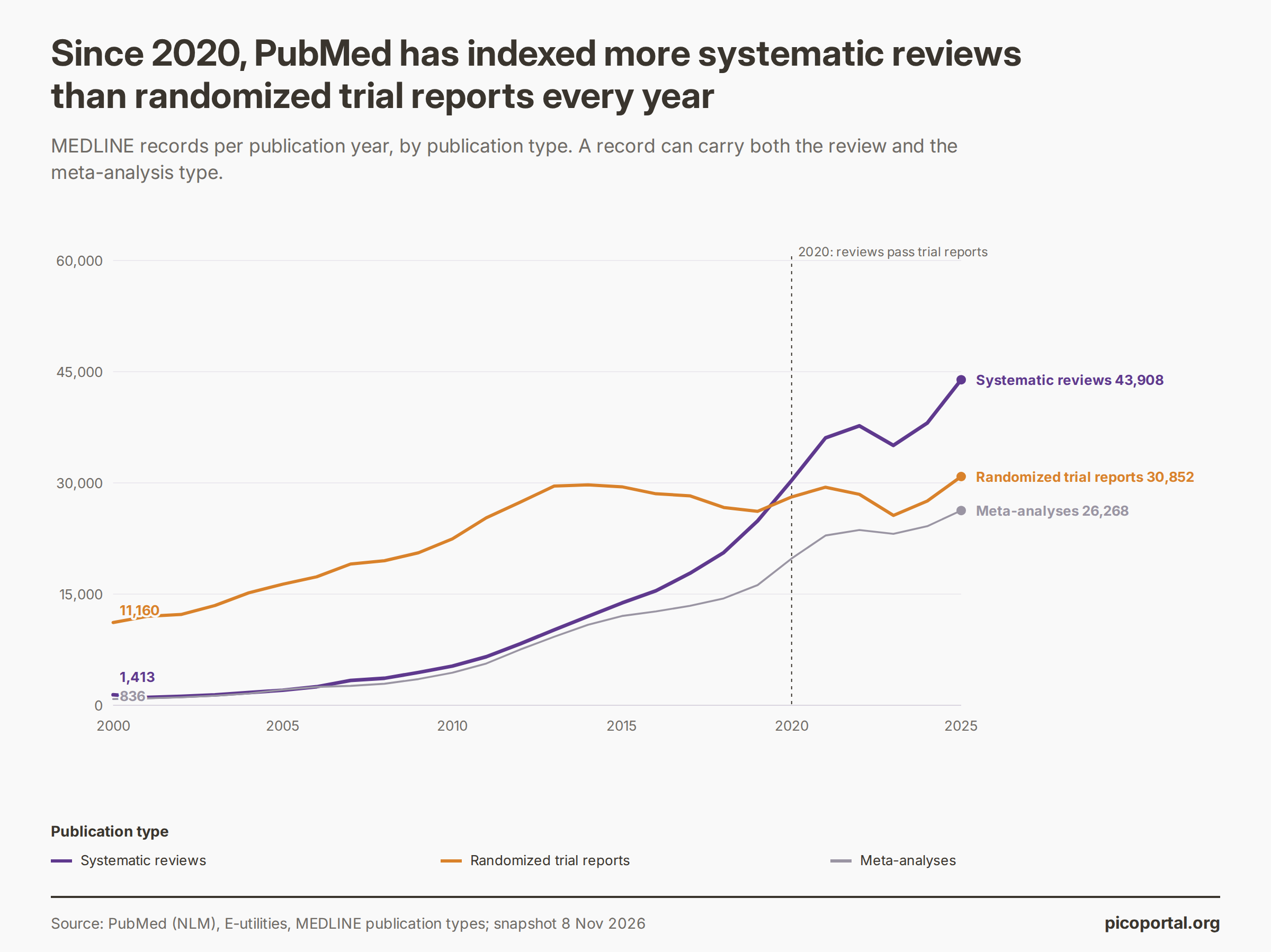
The number of systematic reviews in PubMed was 43,908 in 2025, against 30,852 reports of randomized controlled trials ([PubMed: reviews](https://pubmed.ncbi.nlm.nih.gov/?term=systematic+review%5Bpt%5D+AND+2025%5Bdp%5D), [trials](https://pubmed.ncbi.nlm.nih.gov/?term=randomized+controlled+trial%5Bpt%5D+AND+2025%5Bdp%5D)). Reviews have outnumbered trial reports every year since 2020. In 2000, PubMed indexed 1,413 reviews and 11,160 trial reports.
One question shows what this looks like. PubMed lists 11 evidence syntheses on GLP-1 drugs for obstructive sleep apnea: systematic reviews, meta-analyses, and scoping reviews. Of these, 10 appeared in 2025 or 2026. Four came out in 2025: in [Sleep](https://pubmed.ncbi.nlm.nih.gov/39626095/), the [Journal of Translational Medicine](https://pubmed.ncbi.nlm.nih.gov/40181368/), [Sleep Medicine](https://pubmed.ncbi.nlm.nih.gov/39978242/), and [Sleep Medicine Reviews](https://pubmed.ncbi.nlm.nih.gov/40633481/). Each one asks a slightly different question: all patients, patients with type 2 diabetes, patients without diabetes, or obesity-related apnea. The same search finds six randomized trial reports, three of which report one trial: [SURMOUNT-OSA](https://pubmed.ncbi.nlm.nih.gov/38912654/).
We counted every [systematic review](/blog/systematic-review/), meta-analysis, and randomized trial report that PubMed indexed from 2000 to 2025. We also read random samples and checked our search terms by hand. Below: where the reviews pile up, which review types grow fastest, and what to check before your team starts one more review.
## The number of systematic reviews grew 31-fold since 2000
MEDLINE records per publication year by publication type, 2000 to 2025 (PubMed, snapshot 8 November 2026).
**Reviews.** PubMed indexed 43,908 systematic reviews in 2025, 31 times the number indexed in 2000 ([PubMed](https://pubmed.ncbi.nlm.nih.gov/?term=systematic+review%5Bpt%5D+AND+2025%5Bdp%5D)). That is 120 reviews a day.
**Trial reports.** Reports of randomized controlled trials grew 2.8 times over the same years. All MEDLINE records grew 2.2 times. Reviews passed trial reports in 2020: 30,325 against 28,103 ([PubMed](https://pubmed.ncbi.nlm.nih.gov/?term=systematic+review%5Bpt%5D+AND+2020%5Bdp%5D)).
A trial report is a publication. One trial often has several reports: the main result, then secondary analyses. So there are fewer unique trials than trial reports. The gap between reviews and trials is larger than this chart shows.
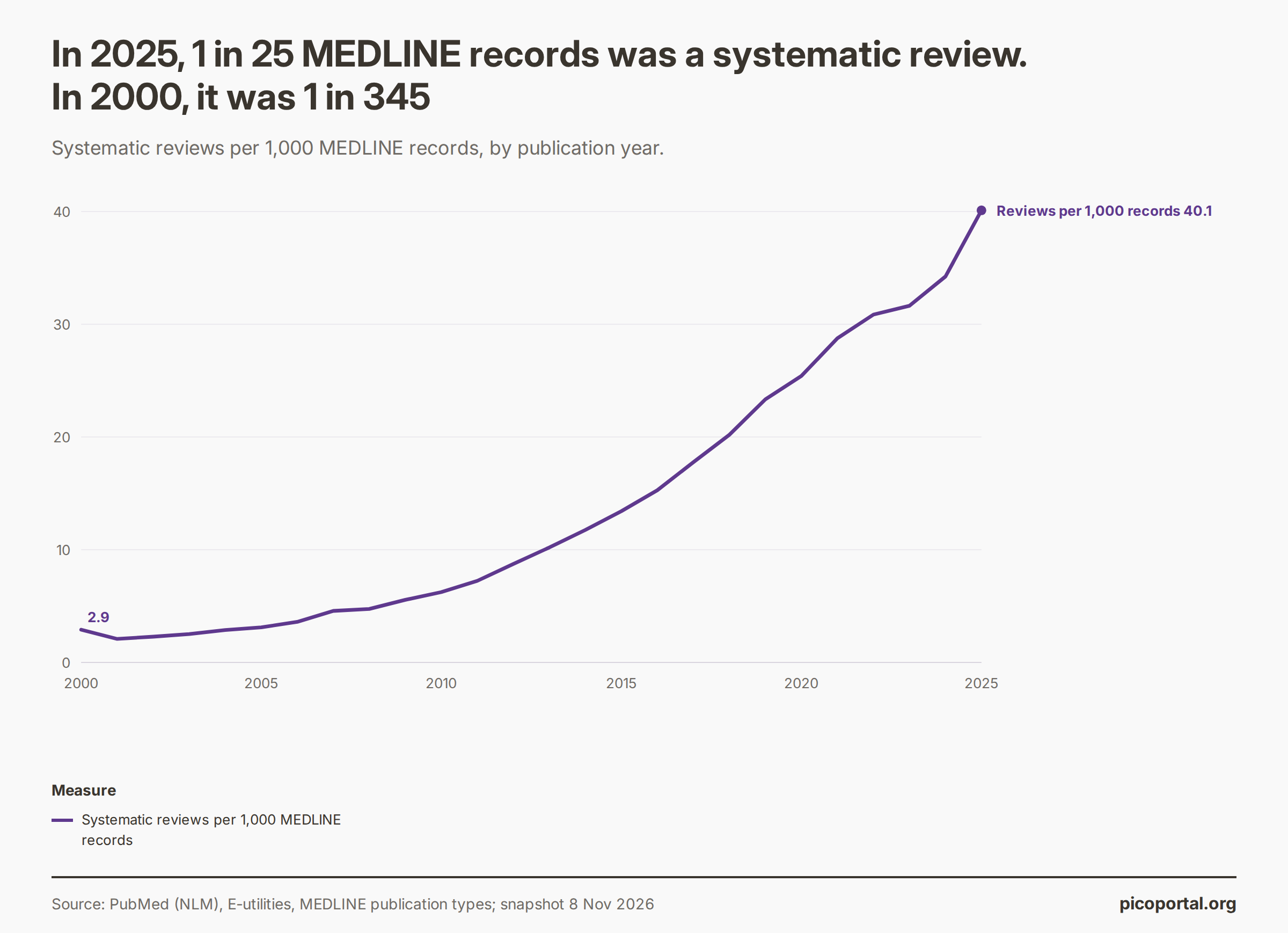
Systematic reviews per 1,000 MEDLINE records of the same publication year (PubMed).
In 2000, one MEDLINE record in 345 was a systematic review. In 2025, it was one in 25 ([PubMed: MEDLINE 2025](https://pubmed.ncbi.nlm.nih.gov/?term=medline%5Bsb%5D+AND+2025%5Bdp%5D)). In 2023, all counts fell together with MEDLINE as a whole, from 1,222,122 records to 1,107,821. The share of reviews still went up that year.
## More new reviews than new trial reports in 21 of 30 diseases
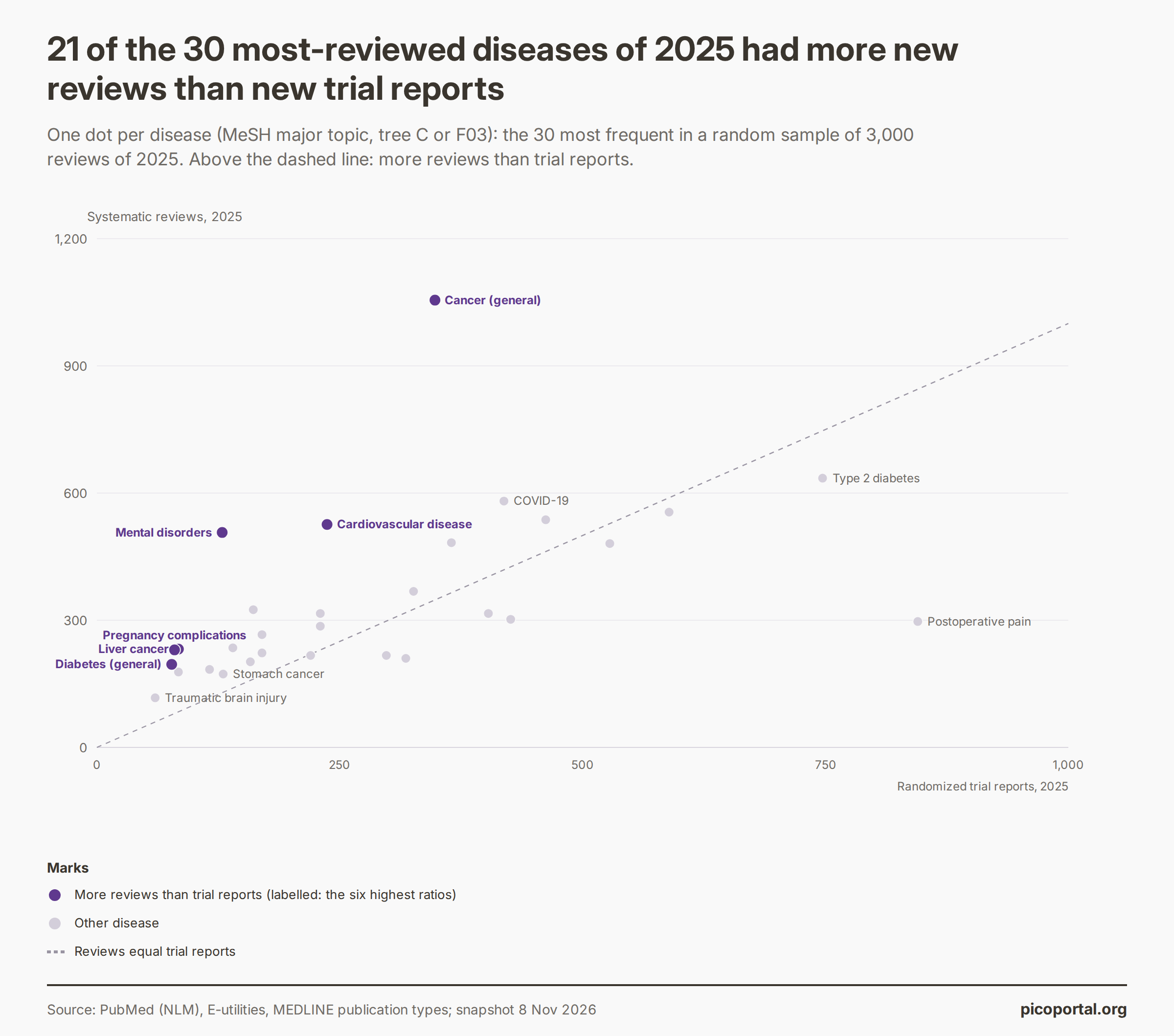
Systematic reviews and randomized trial reports per disease in 2025, the 30 diseases that appear most often in a random sample of 3,000 reviews (PubMed, MeSH major topics).
We took the 30 diseases that appear most often as the main topic of 2025 reviews. For each one, we counted the reviews and the trial reports of 2025 with that main topic. In 21 of the 30, the reviews were more numerous:
- Mental disorders: 507 reviews, 129 trial reports
- Cancer in general: 1,055 reviews, 348 trial reports
- Cardiovascular disease: 526 reviews, 237 trial reports
Each disease has the same search with its own heading. Example: the [PubMed search for mental disorders](https://pubmed.ncbi.nlm.nih.gov/?term=systematic+review%5Bpt%5D+AND+%22Mental+Disorders%22%5Bmajr%3Anoexp%5D+AND+2025%5Bdp%5D).
Some areas go the other way. Postoperative pain had 297 reviews and 845 trial reports ([PubMed](https://pubmed.ncbi.nlm.nih.gov/?term=randomized+controlled+trial%5Bpt%5D+AND+%22Postoperative+Pain%22%5Bmajr%3Anoexp%5D+AND+2025%5Bdp%5D)). Type 2 diabetes had 635 reviews and 747 trial reports.
A review in 2025 can pool trials from many earlier years, so one year of trials is only part of its evidence. The ratio shows something else: in most of these diseases, new reviews now arrive faster than new trial reports.
## GLP-1 drugs: 371 evidence syntheses and 217 trial reports in 2025
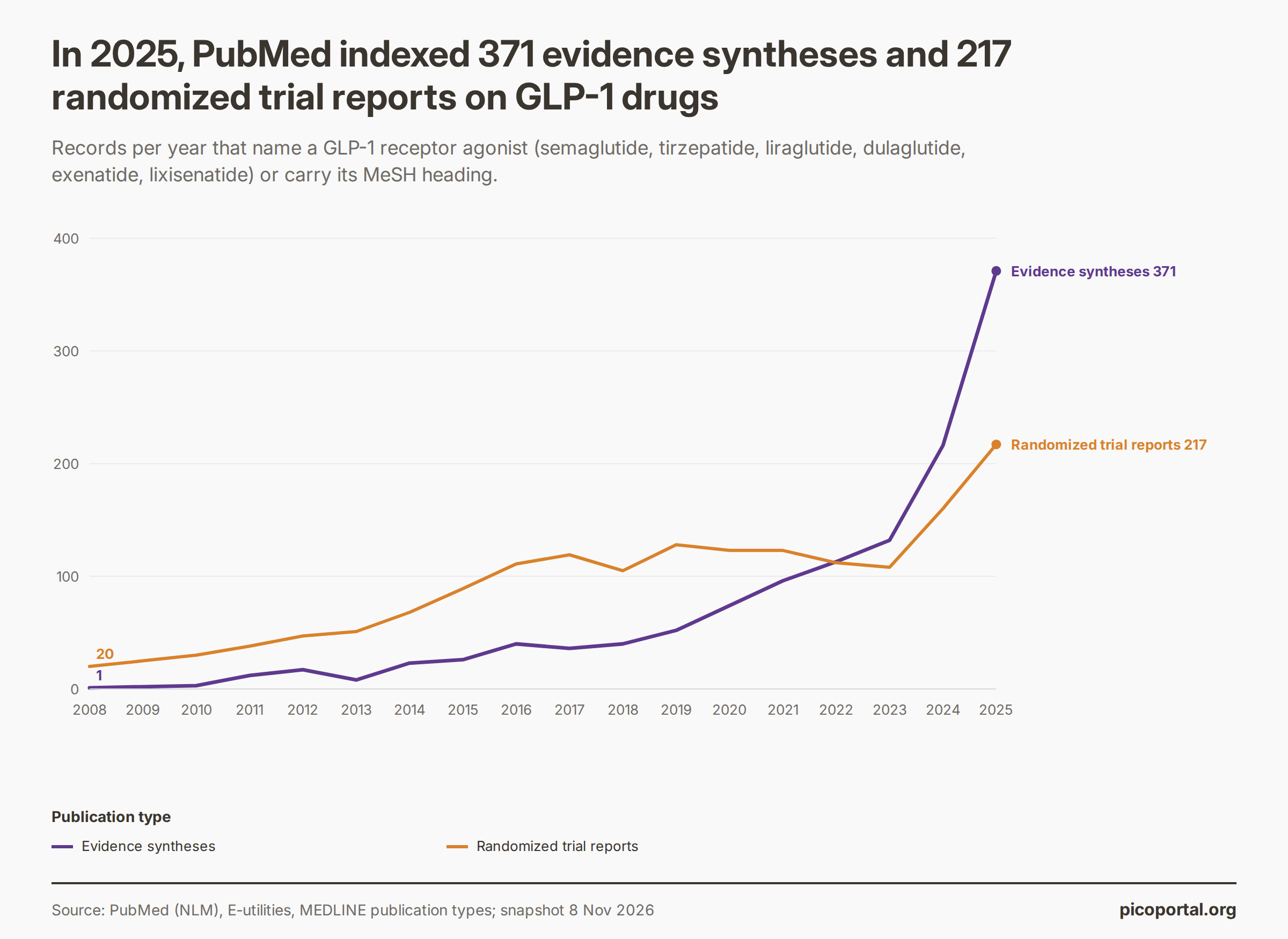
Evidence syntheses and randomized trial reports on GLP-1 receptor agonists per publication year, 2008 to 2025 (PubMed).
GLP-1 receptor agonists such as semaglutide and tirzepatide show the pattern at its fastest. Evidence syntheses on these drugs went from 74 in 2020 to 371 in 2025, five times as many ([PubMed](https://pubmed.ncbi.nlm.nih.gov/?term=%28systematic+review%5Bpt%5D+OR+meta-analysis%5Bpt%5D+OR+scoping+review%5Bpt%5D%29+AND+%28%22Glucagon-Like+Peptide-1+Receptor+Agonists%22%5Bmh%5D+OR+semaglutide%5Btiab%5D+OR+tirzepatide%5Btiab%5D+OR+liraglutide%5Btiab%5D+OR+dulaglutide%5Btiab%5D+OR+exenatide%5Btiab%5D+OR+lixisenatide%5Btiab%5D+OR+%22GLP-1+receptor+agonist%22%5Btiab%5D+OR+%22GLP-1+receptor+agonists%22%5Btiab%5D+OR+%22GLP-1+RA%22%5Btiab%5D+OR+%22GLP-1+RAs%22%5Btiab%5D%29+AND+2025%5Bdp%5D)). They passed trial reports in 2022 and stayed above them.
The year 2026 is not over, and the count has already passed 2025. Up to 8 November 2026, PubMed indexed 434 evidence syntheses and 192 trial reports on GLP-1 drugs ([PubMed](https://pubmed.ncbi.nlm.nih.gov/?term=%28systematic+review%5Bpt%5D+OR+meta-analysis%5Bpt%5D+OR+scoping+review%5Bpt%5D%29+AND+%28%22Glucagon-Like+Peptide-1+Receptor+Agonists%22%5Bmh%5D+OR+semaglutide%5Btiab%5D+OR+tirzepatide%5Btiab%5D+OR+liraglutide%5Btiab%5D+OR+dulaglutide%5Btiab%5D+OR+exenatide%5Btiab%5D+OR+lixisenatide%5Btiab%5D+OR+%22GLP-1+receptor+agonist%22%5Btiab%5D+OR+%22GLP-1+receptor+agonists%22%5Btiab%5D+OR+%22GLP-1+RA%22%5Btiab%5D+OR+%22GLP-1+RAs%22%5Btiab%5D%29+AND+2026%5Bdp%5D)).
The sleep apnea example at the top shows how this happens: a small set of trials feeds many reviews that ask almost the same question.
## Scoping reviews, umbrella reviews, and network meta-analyses grow fastest
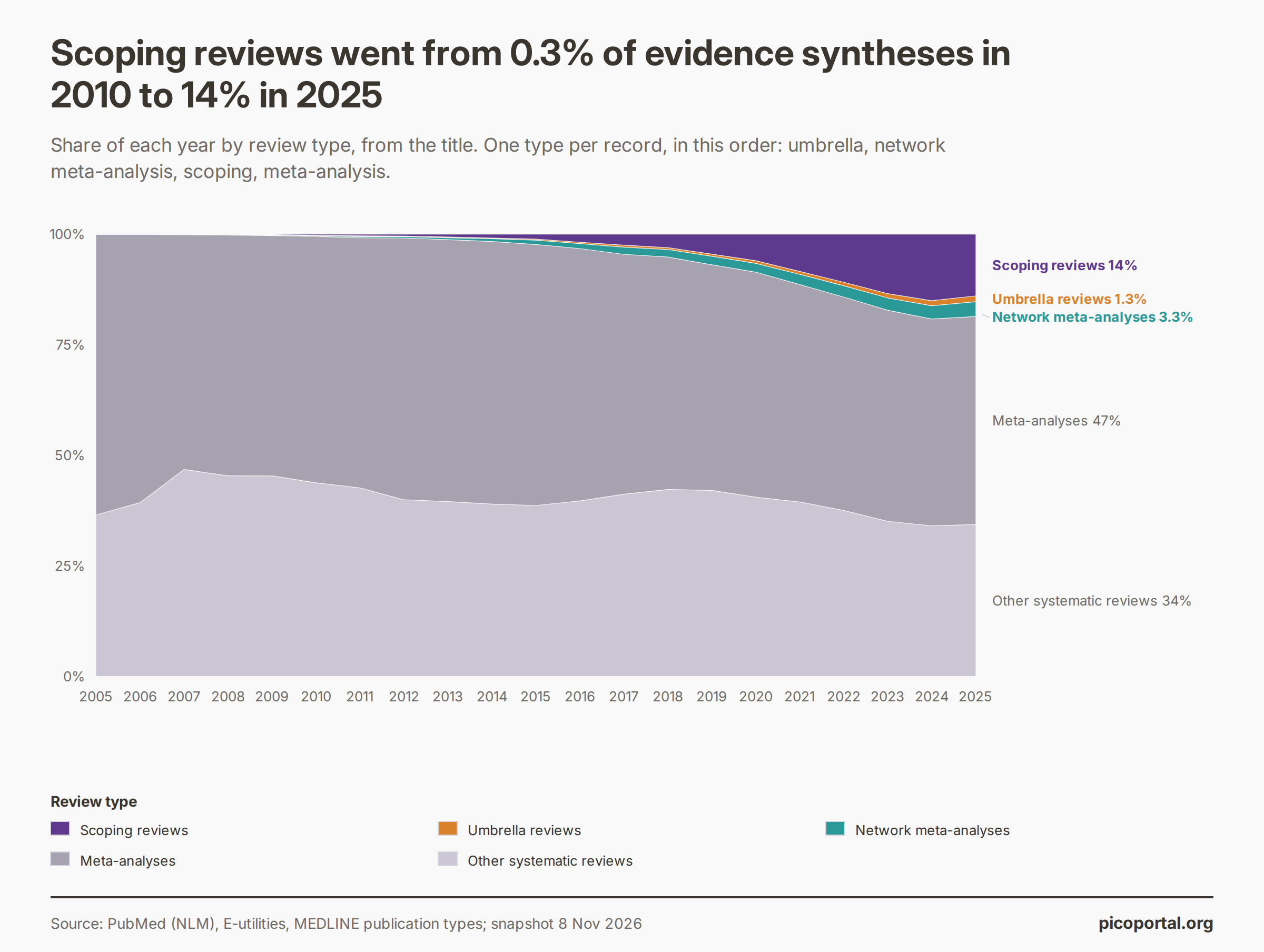
Evidence syntheses by review type as shares of each year, 2005 to 2025; the type comes from the title (PubMed).
**Scoping reviews** went from 21 in 2010 to 7,826 in 2025, from 0.3% of all evidence syntheses to 14% ([PubMed](https://pubmed.ncbi.nlm.nih.gov/?term=%28systematic+review%5Bpt%5D+OR+meta-analysis%5Bpt%5D+OR+scoping+review%5Bpt%5D%29+AND+%28%22scoping+review%22%5Bti%5D+OR+%22scoping+reviews%22%5Bti%5D+OR+scoping+review%5Bpt%5D%29+NOT+%28%22umbrella+review%22%5Bti%5D+OR+%22umbrella+reviews%22%5Bti%5D+OR+%22overview+of+reviews%22%5Bti%5D+OR+%22overview+of+systematic+reviews%22%5Bti%5D+OR+%22review+of+reviews%22%5Bti%5D+OR+%22review+of+systematic+reviews%22%5Bti%5D+OR+%22review+of+meta-analyses%22%5Bti%5D%29+NOT+%28%22network+meta-analysis%22%5Bti%5D+OR+%22network+meta-analyses%22%5Bti%5D+OR+%22network+meta+analysis%22%5Bti%5D%29+AND+2025%5Bdp%5D)).
**Umbrella reviews**, which are reviews of reviews, went from 10 to 751 ([PubMed](https://pubmed.ncbi.nlm.nih.gov/?term=%28systematic+review%5Bpt%5D+OR+meta-analysis%5Bpt%5D+OR+scoping+review%5Bpt%5D%29+AND+%28%22umbrella+review%22%5Bti%5D+OR+%22umbrella+reviews%22%5Bti%5D+OR+%22overview+of+reviews%22%5Bti%5D+OR+%22overview+of+systematic+reviews%22%5Bti%5D+OR+%22review+of+reviews%22%5Bti%5D+OR+%22review+of+systematic+reviews%22%5Bti%5D+OR+%22review+of+meta-analyses%22%5Bti%5D%29+AND+2025%5Bdp%5D)). An umbrella review makes sense only when one question already has many reviews, so its growth follows the growth of everything else.
**Network meta-analyses**, which compare many treatments in one model, went from 11 to 1,870 ([PubMed](https://pubmed.ncbi.nlm.nih.gov/?term=%28systematic+review%5Bpt%5D+OR+meta-analysis%5Bpt%5D+OR+scoping+review%5Bpt%5D%29+AND+%28%22network+meta-analysis%22%5Bti%5D+OR+%22network+meta-analyses%22%5Bti%5D+OR+%22network+meta+analysis%22%5Bti%5D%29+NOT+%28%22umbrella+review%22%5Bti%5D+OR+%22umbrella+reviews%22%5Bti%5D+OR+%22overview+of+reviews%22%5Bti%5D+OR+%22overview+of+systematic+reviews%22%5Bti%5D+OR+%22review+of+reviews%22%5Bti%5D+OR+%22review+of+systematic+reviews%22%5Bti%5D+OR+%22review+of+meta-analyses%22%5Bti%5D%29+AND+2025%5Bdp%5D)).
The classic [meta-analysis](/blog/meta-analysis/) is still the largest type. However, its share fell to 47% in 2025.
## Review teams doubled: from three authors to six
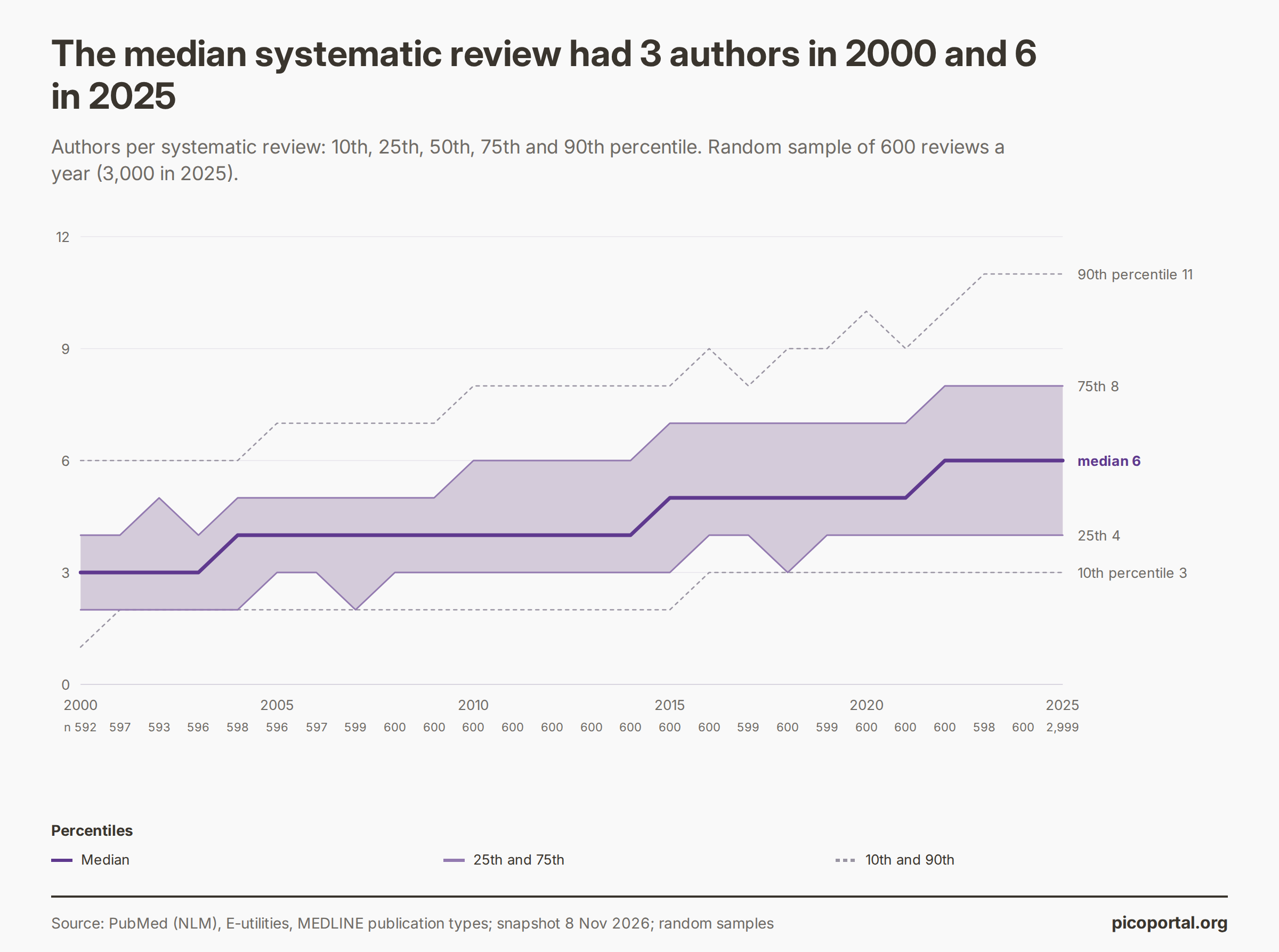
Authors per systematic review, 10th to 90th percentile, random samples of 600 reviews a year and 3,000 in 2025 (PubMed).
The median systematic review had three authors in 2000 and six in 2025. The 90th percentile went from six authors to 11. In 2025, 17% of reviews had 10 or more authors; in 2000, 1% did.
The methods ask for more people. The [Cochrane Handbook](https://training.cochrane.org/handbook/current) asks for at least two people who work independently at study selection, data extraction, and risk of bias assessment. Part of the growth can also come from authorship practice, so the author count is an upper limit for the people who did the work.
## Before you start a review: check PROSPERO registration and existing reviews
PubMed adds about 120 systematic reviews a day. So the first step of a new review is a search for the old ones.
1. Search for published reviews on your question: [PubMed with the systematic review filter](https://pubmed.ncbi.nlm.nih.gov/?term=systematic%5Bsb%5D), the [Cochrane Library](https://www.cochranelibrary.com/), and [Epistemonikos](https://www.epistemonikos.org/).
2. Search the registers for reviews in progress: [PROSPERO](https://www.crd.york.ac.uk/prospero/) and [OSF Registries](https://osf.io/registries).
3. If a recent review answers your question, decide: update it, extend it to a new population, or stop.
4. Write the reason for your review in the protocol. [PRISMA 2020](https://www.bmj.com/content/372/bmj.n71) item 3 asks for the rationale in the context of existing knowledge.
5. Register your protocol before screening starts. PRISMA 2020 item 24a asks for the register name and number.
A larger team also needs one place for the work. PICO Portal keeps screening, full-text review, risk of bias, data extraction, and the [PRISMA flow diagram](/blog/the-prisma-2020-flow-diagram-explained-box-by-box/) in one workspace. Every reviewer works on the same records. [See the features](/features/).
## How we counted reviews and trial reports
### Data
**Source.** PubMed through the NCBI E-utilities, snapshot 8 November 2026. Each count is the number of records with that publication year. The year 2026 is incomplete and is not in the trends.
**Publication types.** Systematic reviews, meta-analyses, and randomized trial reports are MEDLINE publication types. NLM added the Systematic Review type in 2019 and [applied it to older MEDLINE records](https://www.nlm.nih.gov/pubs/techbull/nd18/nd18_medline_data_changes_2019.html), so one rule covers 2000 to 2025.
**Evidence syntheses.** Records with the systematic review, meta-analysis, or scoping review type. The review type comes from the title, one type per record, in this order: umbrella review, network meta-analysis, scoping review, meta-analysis.
**GLP-1 drugs.** The MeSH heading for GLP-1 receptor agonists, or semaglutide, tirzepatide, liraglutide, dulaglutide, exenatide, or lixisenatide in the title or abstract.
**Diseases.** MeSH major topics in the Diseases or Mental Disorders tree, without narrower headings, for reviews and trial reports alike.
**Samples.** Random samples of 600 systematic reviews a year, and 3,000 in 2025, with a fixed seed. The authors chart counts the authors that PubMed lists.
### Checks and limits
**Precision check.** We read 100 random 2025 records for each main search. Reviews: 97 correct, one false match, two unclear. Trial reports: 93 correct, two false, five unclear. GLP-1 syntheses: 94 correct, two false, four unclear. Review types, 30 records each: scoping 30 of 30, umbrella 30 of 30, network meta-analysis 29 of 30.
**Limits.** MEDLINE indexes most of the biomedical literature but not all of it. Publication types come from NLM indexing, so a mislabeled record counts as labeled.